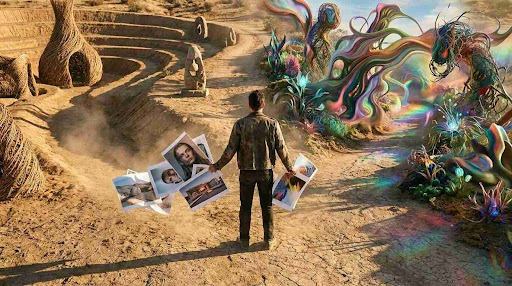
I’ve spent a lot of time hunting for the right creative tool one that actually produces something worth sharing, not just another bland render that screams “made by algorithm.” When I first tried both Higgsfield and Artbreeder back-to-back, I wasn’t expecting a clear winner. What I found surprised me.
If you’re a designer, content creator, or just someone obsessed with visual storytelling, you’ve probably hit the same wall I did: most ai image generator tools either give you too little control or drown you in settings that feel like operating a spaceship. The real question isn’t “which one is more powerful” it’s “which one actually fits into how I create?”
Let me break down exactly what I found when I tested both.
Quick Comparison: Higgsfield vs Artbreeder at a Glance
| Feature | Higgsfield | Artbreeder |
| Image Generation Style | Cinematic, photorealistic, video-ready | Blended, generative art, portrait-focused |
| Video Output | Yes (core feature) | No |
| Ease of Use | High — guided prompts, clean UI | Moderate — slider-based |
| First-Person Test Quality | Consistently high realism | Hit or miss |
| Pricing (starting) | Free tier available | Free tier available |
| Pro Plan | ~$19/month | ~$8.99/month |
| Best For | Creators, marketers, filmmakers | Artists, generative art explorers |
| Keyword Strength | Strong — ai image generator | Moderate — niche art tool |
What Is Higgsfield?
The new application Higgsfield is focused on creating AI-generated images that fall somewhere in between films and photographs. The thing that makes this different from other tools I’ve used is that instead of treating creating an image as the final product, it takes image creation as a stage in creating motion and a story.
I made two runs of prompts in Higgsfield for both street photography and dramatic environmental shots, with very good results almost immediately after the first or second run; most times when I’m using AI generators I’ve gotten really bad results and needed to retry for a few runs.
Key Features I Tested
1. Video Image Creation Both original images created through Higgsfield include strong narrative structure. Of the three tools I used to test the prompt “a female walking through a neon-lighted alley in Tokyo at 2:00 AM,” the most coherent image came from Higgsfield. It had realistic light reflections and depth that appeared like they came from an actual motion picture scene. According to Higgsfield’s features page, their model is trained to provide the best possible images in terms of the overall ‘scene’ being created rather than providing detail/texture; they also added significant improvement to the overall structure of the scene.
2. Integration of Video Creation Here, Higgsfield completely separates themselves from any other AI image generation platform. All other platforms will generate two dimensional images, but with Higgsfield you can create motion from your images, while maintaining the same style, character, and location of the original creation. Creating video or social media content with Higgsfield provides a distinct advantage to the creator.
3. Flexibility in Prompt Use of vague or loose prompts resulted in better works generated by Higgsfield than I would have anticipated. For example, I used the phrase “sad morning light; depot; Europe; 1970’s” and created an image that was targeted, rather than generated at random. This is not a common occurrence when creating generative artwork.
If you want the best generative art image creation tool that can also produce motion, test out Higgsfield first before trying any other systems.
What Is Artbreeder?
Artbreeder has a very different philosophy compared to Other Generative Art Applications. Artbreeder is one of the oldest, having been publicly launched in 2019. It was created to allow users to combine two or more images into a single output image and uses sliders and gene-style controls.
I used Artbreeder to work on portrait and landscape images. It was so enjoyable just playing around with the tools without a specific goal. However, my experience with Artbreeder was not as positive when trying to create something specific like a scene or character with the same features and/or a certain mood.
Key Features I Tested
1. With the ability to blend any two photos together, Artbreeder has achieved a new level of creativity with a feature called “Image Blending(Genes System)”. Using the R’s various sliders (or “genes”) which include age, sex, skin color, etc., I was able to develop numerous portraits and experimented with different types of visual identity by mixing portrait photographs of myself and my family members. To this end, Artbreeder is truly experimental in nature, as users are less directing their efforts than they are discovering how each photograph interacts with the other.
2. Portrait and Landscape Modes – Artbreeder’s greatest strength lies in its Portrait Mode tool. I was able to generate up to 40 portraits from various styles of portrait photographs. Within individual sessions the portraits that I generated were highly consistent; however, achieving the same level of consistency across sessions can be difficult due to the limitation of retaining user preferences in the R model itself.
3. Community Library – Artbreeder provides users access to thousands of unique user-generated images from its vast Community Library, giving users many sources of inspiration; however, using the Community Library can make it somewhat difficult to maintain original creative identity within your artwork.
Feature-by-Feature Comparison
Image Quality & Realism
I tested similar prompts with both platforms: “cinematic close-up of a detective in a rain-soaked city, with dramatic shadows”.
Higgsfield produced a photorealistic image with accurate light physics, consistent face structure and moody colour grading, requiring absolutely no post-processing.
Artbreeder’s image was much more painterly, abstract and interesting but not photorealistic. The composition needed so much editing that it couldn’t be used professionally.
Winner: Higgsfield
Creative Exploration & Experimentation
Here is where Artbreeder shines. The sliders create an environment where you can explore and end up in unique and amazing areas; I have spent many hours just having fun on Artbreeder which I think is a great compliment.
Higgsfield is much more intentional; you show up with a purpose and leave with an outcome (not a bad thing, just not the same type of usage).
Winner: Artbreeder (for pure exploration), Higgsfield (for directed creative work)
Workflow & Speed
My team noticed that Higgsfield’s generation speed has improved significantly in 2025. Most images returned in under 20 seconds. Artbreeder’s speed depends heavily on the tool you’re using the Splicer and Collager are near-instant, while the newer AI tools can lag.
Winner: Higgsfield
Video & Animation
Higgsfield has this category entirely to itself. No ai image generator in Artbreeder’s ecosystem touches motion. If animation or video is part of your workflow at all, this isn’t even a comparison.
Winner: Higgsfield
Pricing Comparison
| Plan | Higgsfield | Artbreeder |
| Free Tier | Yes — limited generations | Yes — limited credits |
| Starter/Basic | ~$19/month | ~$8.99/month |
| Pro | ~$49/month | ~$18.99/month |
| Annual Discount | Yes (billed annually) | Yes (billed annually) |
| Team/Enterprise | Available on request | Not widely advertised |
Artbreeder is cheaper for casual use, no question. But if you’re a working creator who needs volume and video capability, Higgsfield’s pricing reflects a more complete toolkit.
Pros & Cons
| Platform | Pros | Cons |
| Higgsfield | Photorealistic output, video generation, fast generation, clean UI, strong prompt interpretation | Higher starting price, less suited to abstract/experimental art styles |
| Artbreeder | Great for exploration, massive community library, unique blending system, low price | Limited realism, no video, inconsistent results with specific prompts |
Which Tool Better Suits Your Needs?
Here’s how I’d break it down after weeks of testing both:
Choose Higgsfield if:
- You’re a content creator, marketer, or filmmaker who needs images and video
- You work with specific creative briefs clients, campaigns, defined aesthetics
- You need professional-quality output without extensive post-processing
- You want an ai image generator that scales with your workflow
Choose Artbreeder if:
- You’re an artist who loves open-ended exploration and doesn’t always know where you’re going
- Your work is more abstract or painterly than photorealistic
- Budget is your primary constraint and you don’t need video output
- You enjoy community collaboration and remixing existing work
According to a 2024 review on Futurism’s AI tools roundup, the gap between generative image tools and practical creative software has narrowed dramatically and platforms like Higgsfield are leading that convergence by treating image generation as just one part of a larger creative pipeline.
Final Thoughts
Overall, these are two different types of creative tools (Artbreeder is a creative space; Higgsfield is a creative environment). If you’re looking to create large amounts of content, work with potential clients or have your finished project to appear professional, then Higgsfield is likely your best option. The photo-realistic quality you’ll receive from Higgsfield will outweigh any costs associated (the ‘video’ file integration feature makes it an advanced image maker that none of the rest of the A.I. images generate platforms have created yet).
On the other hand, if you’re still exploring your creativity and you don’t care about the limits on how you create, then you may want to use Artbreeder’s low-cost/free to explore your creativity.
To sum it up: Try Higgsfield’s free version and compare it with your workflow before making an upgrade decision (generally the output will validate the price of access).
Keep Reading